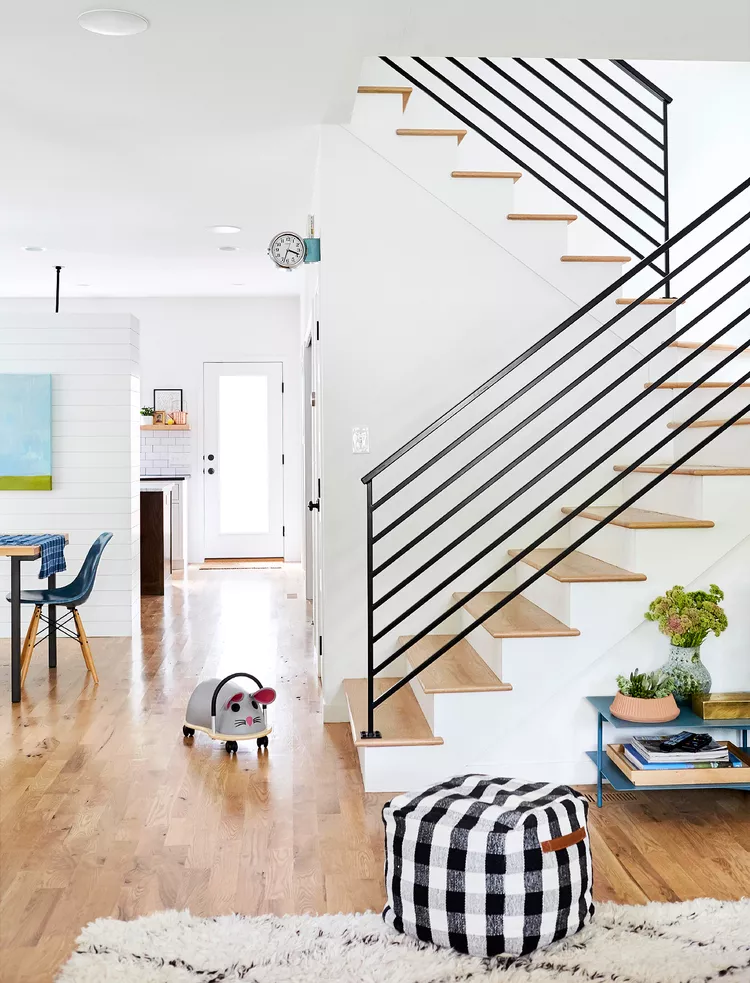
A handrail is most useful when support begins before the first difficult movement and continues through the final step. Handrail extension ideas focus on improving those transition points so users don’t have to release the rail too early or reach awkwardly before climbing.
Extensions can be simple, but their shape, clearance, return, and surrounding space all deserve careful planning.
Look Closely at the First and Last Steps
Many stair rails begin directly above the first riser and stop at the last one. That arrangement can leave little support while a person is preparing to step onto the staircase or moving onto the landing.
An extension provides additional gripping space before or after the sloped section. The exact configuration depends on the staircase, walls, doors, circulation space, and applicable building requirements.
Protect the Walking Area Around the Rail
A longer handrail shouldn’t create a new obstruction. Extensions need to remain easy to grip while avoiding sharp projections into hallways, door paths, or narrow landings.
People considering broader home planning concepts can apply the same circulation principle here: every added feature should be evaluated from the perspective of someone walking past it as well as someone using it.
Return the End Neatly
Many designs turn or return the rail toward the wall, floor, or supporting structure. A finished return can reduce exposed ends that might catch clothing or bags.
Keep the Grip Continuous
Transitions between brackets, rail sections, and extensions should feel predictable in the hand. Abrupt size changes or decorative interruptions can make the rail less comfortable to follow.
Reviewing residential improvement ideas may offer aesthetic inspiration, but grip quality should remain the priority. Decorative profiles can still work when the graspable portion is consistent and comfortable.
| Feature | Useful Goal | Planning Issue |
|---|---|---|
| Top extension | Support onto landing | Door and hallway clearance |
| Bottom extension | Support before climbing | Walking path obstruction |
| Returned end | Cleaner termination | Adequate hand clearance |
| Continuous grip | Predictable support | Bracket interference |
Coordinate Rails With Walls and Lighting
A rail that visually blends into the wall may be harder to locate, particularly under dim lighting. Moderate color contrast can make the handrail easier to identify without turning it into a dominant decorative element.
Broader home design perspectives can also inspire material coordination. Wood, painted metal, and other finishes can complement the interior while remaining distinct enough from the background.
Lighting at stair approaches is especially useful because the first and last steps are transition points. Avoid placing switches, décor, or furniture where they interfere with reaching the rail.
Mistakes That Reduce the Benefit
Extending a rail without checking the surrounding walking route can create a projection people must move around. Another mistake is ending the extension with a sharp or exposed termination.
Loose brackets are an even bigger concern. A rail may look solid while developing movement over time, especially when repeatedly used for support.
Finally, don’t treat an extension as a substitute for fixing damaged steps, uneven surfaces, weak lighting, or other stair problems. The stair system needs to work together.
Frequently Asked Questions
Can an existing stair handrail be extended?
Often it can, although the method depends on the existing rail material, wall structure, brackets, and available space. A compatible extension may require additional mounting support.
Should handrails contrast with the wall?
Visible contrast can make a rail easier to locate, especially in dim lighting. The colors don’t need to clash; they only need enough difference for the rail to stand out clearly.
Do both ends of a staircase need attention?
Yes. The bottom is where a person prepares to climb, while the top is where movement shifts onto a landing. Both transitions can benefit from thoughtful support.
Design the Transition, Not Only the Rail
Handrail extension ideas are most useful when the beginning and ending of the staircase are treated as part of the walking route. Check grip continuity, wall clearance, lighting, nearby doors, and the shape of each rail end.
A well-planned extension should feel natural to reach and should never force someone else to detour around it.